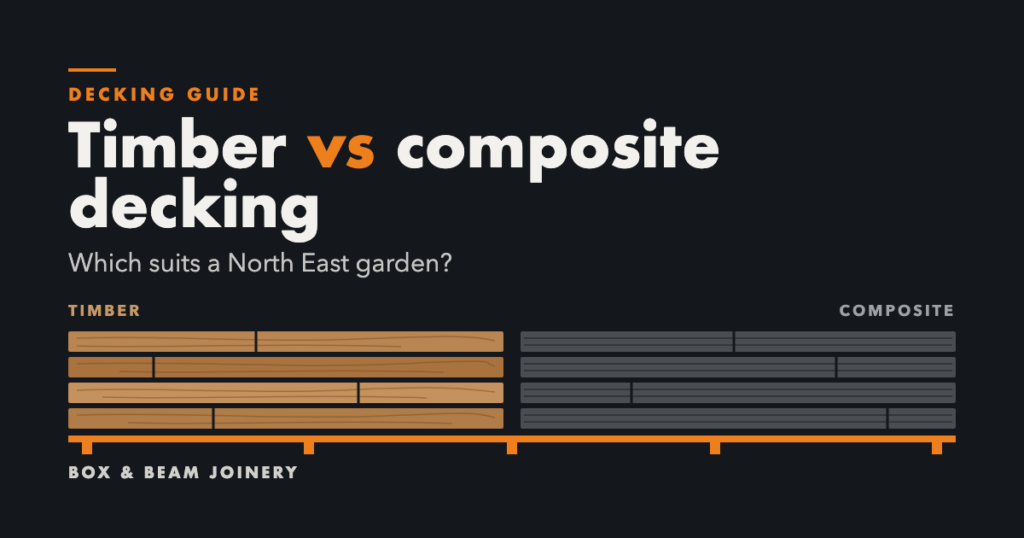
Timber vs composite decking comes down to one question: how much looking after do you want to do once the deck is down? We build both, and in a North East garden each one has a clear trade-off. Here’s how they compare in plain words, and why the frame underneath is the part that decides how long the deck lasts.
Timber decking: what you get
Timber is cheaper to buy, it’s warmer underfoot, and it looks like what it is. If you like the look of real wood in the garden, that counts for a lot.
The trade-off is upkeep. Timber wants re-treating. In a North East winter it will move, silver off (go grey as the surface weathers) and go slippery in the shaded corner if nobody touches it. None of that means the deck has failed. It means timber is a material that asks for some attention, and you either give it that or live with how it weathers.
So timber suits you if:
- You like the look and feel of wood and want the deck to look like timber
- You don’t mind getting a brush out and re-treating it
- You’d rather spend less on the boards up front
If the deck sits partly in shade, think about where people actually walk. That shaded corner is where timber goes slippery if it’s left, so it’s the bit to keep an eye on.
Composite decking: what you get
Composite costs more to buy, and then there’s close to nothing to do. It doesn’t need staining, it doesn’t splinter, and the colour it is on the day it goes down is roughly the colour it stays.
There are two composite decks in Alex’s own job book:
- North East, August 2026: a completely new subframe in 5×2 treated timber, with rosewood composite decking on top. Joist hangers (metal brackets that hold the end of each joist) and protective joist tape underneath, and concealed clips for a clean finish, so there isn’t a screw head in sight.
- Blyth: black composite decking under a chunky timber pergola, built along the back of a new-build house, with new fencing round it.
You can see both on our work.
Composite suits you if you’d rather not think about the deck again once it’s built. You pay more for the boards, and in return you skip the staining and the splinters.
Timber vs composite decking side by side
Here’s the comparison in one place, as our decking page sets it out:
- To buy: timber is cheaper; composite costs more up front.
- Upkeep: timber wants re-treating; composite doesn’t need staining.
- Winter: timber will move and silver off in a North East winter, and go slippery in the shade if left; composite stays roughly the colour it went down.
- Underfoot: timber is warmer; composite doesn’t splinter.
- Look: timber looks like timber, and changes as it weathers.
Which one is right depends on how much looking after you want to do down the line. If you’d rather not think about it again, composite. If you like the look and don’t mind a brush and some re-treating, timber.
There isn’t a wrong answer between the two. There is a wrong way to build either of them, though, and that’s the next bit.
Why the subframe matters more than the boards
What actually decides it is the frame underneath, not the boards on top. A good deck is a good subframe (the frame of joists the boards sit on) with something nailed to it.
When we build a deck, the subframe gets the attention:
- Treated timber sized for the span, rather than whatever was cheapest
- Sat on proper supports
- Joist hangers where they belong
- Protective tape over the top of every joist, so water sits on the tape instead of soaking into the end grain
None of it shows on the day the deck is finished. It’s what decides whether the deck is still flat and solid long after the last board goes down.
That’s why we build the subframe as well, not just lay the boards. Laying good boards onto somebody else’s tired frame is how a deck ends up bouncing. If there’s an old deck in the way, taking it up and getting rid of it is written into the quote, so you can see what it adds before you agree. The ground underneath gets a proper look at the same time.
Planning a deck in a North East garden
We build decks across Newcastle upon Tyne and Northumberland, from Gosforth, Jesmond, Heaton and Ponteland north through Cramlington, Bedlington and Ashington to Morpeth, where we’re based.
A sloping garden, or a drain or inspection cover somewhere inconvenient, isn’t a problem as long as somebody looks before the timber is ordered. That’s what the free visit is for: a look at the garden, the slope and what’s under any old deck, then the scope and the cost in writing.
Worth knowing: we don’t price decking per square metre. A deck is quoted by the days it takes, plus the timber or composite you choose. A rate per square metre hides the subframe, which is the half of the job that decides how long the deck lasts.
A deck can be built any time the ground isn’t frozen or waterlogged. Asking in autumn or winter gives you the most choice of dates, and the deck is finished and settled before you want to sit on it.
There’s more to a garden than the deck, too. Steps off the deck, pergolas, raised planters, built-in seating, fencing and gates are all on our garden decking page.
Timber and composite decking questions
Is composite decking better than timber?
Neither is better across the board. Composite costs more to buy and asks almost nothing of you afterwards. Timber costs less, feels warmer underfoot and looks like timber, but it wants re-treating and will move and silver off in a North East winter.
Do you build the subframe as well, or only lay the boards?
The subframe as well, and it’s the part of the job worth paying for: treated timber sized for the span, on proper supports, with joist hangers and protective tape over the joists.
Do you take away the old decking?
Yes. Taking up the old deck and getting rid of it is written into the quote, so you can see what it adds before you agree.
How long does a deck take?
It depends on the size of the deck and whether there are steps or a pergola. Because we price by the day, your written quote tells you how many days it will take before you agree to anything.
Is there a deposit, and when do I pay the rest?
A deposit secures the booking and we agree a start date together. The balance is paid at the end, once we’ve walked round the finished deck with you and you’re happy with it.
Planning a deck for next summer, timber or composite? Get the price in writing now. Tell Alex what needs doing. Your quote is free and in writing.